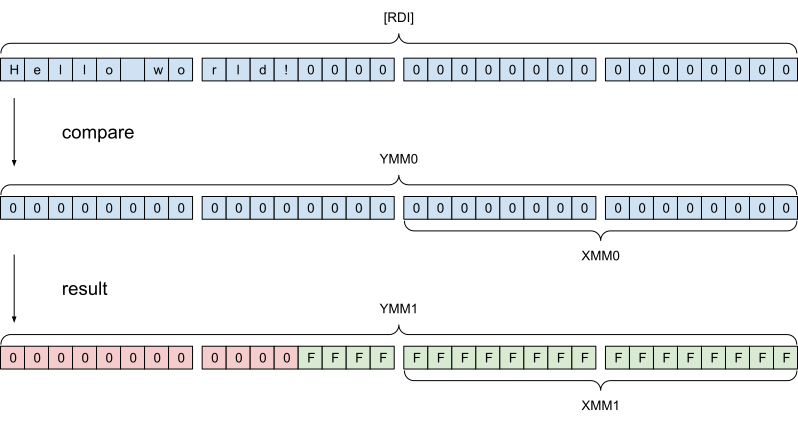
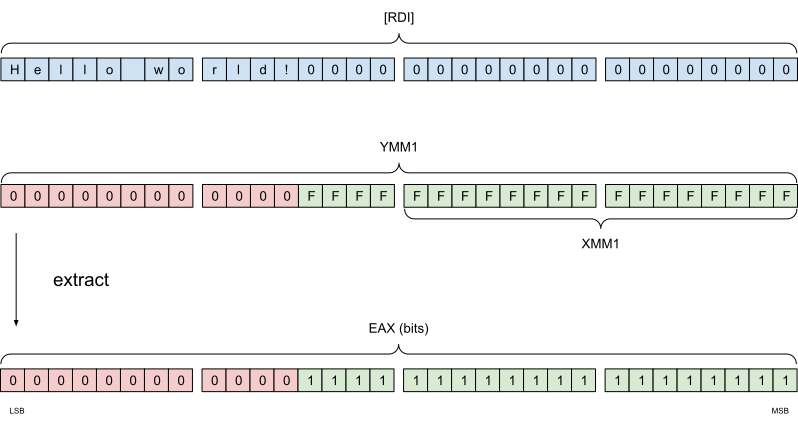
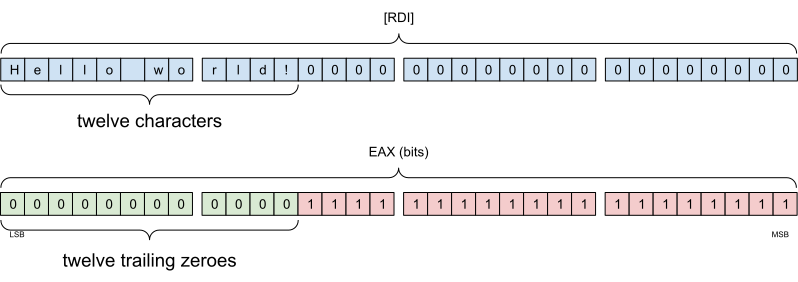
If you remove the first word from the string
"hello world", what should the result be? This is the story
of how we discovered that the answer could be your root password!
Introduction
All x86-64 CPUs have a set of 128-bit vector registers called the
XMM registers. You can never have enough bits, so recent
CPUs have extended the width of those registers up to 256-bit and even
512-bits.
The 256-bit extended registers are called YMM, and the
512-bit registers are ZMM.
These big registers are useful in lots of situations, not just number
crunching! They’re even used by standard C library functions, like
strcmp, memcpy, strlen and so
on.
Let’s take a look at an example. Here are the first few instructions
of glibc’s AVX2 optimized strlen:
Now we have the position of the first nul byte, in just four machine
instructions!
You can probably imagine just how often strlen is
running on your system right now, but suffice to say, bits and bytes are
flowing into these vector registers from all over your system
constantly.
Zeroing Registers
You might have noticed that I missed one instruction, and that’s
vzeroupper.
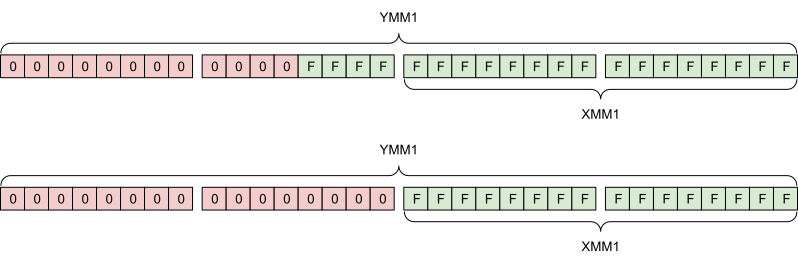
You guessed it, vzeroupper will zero the upper bits of
the vector registers.
The reason we do this is because if you mix XMM and
YMM registers, the XMM registers automatically
get promoted to full width. It’s a bit like integer promotion in C.
This works fine, but superscalar
processors need to track dependencies so that they know which operations
can be parallelized. This promotion adds a dependency on those upper
bits, and that causes unnecessary stalls while the processor waits for
results it didn’t really need.
These stalls are what glibc is trying to avoid with
vzeroupper. Now any future results won’t depend on what
those bits are, so we safely avoid that bottleneck!
The Vector Register File
Now that we know whatvzeroupper does,
how does it do it?
Your processor doesn’t have a single physical location where each
register lives, it has what’s called a Register
File and a Register Allocation Table. This is a bit
like managing the heap with malloc and free,
if you think of each register as a pointer. The RAT keeps track of what
space in the register file is assigned to which register.
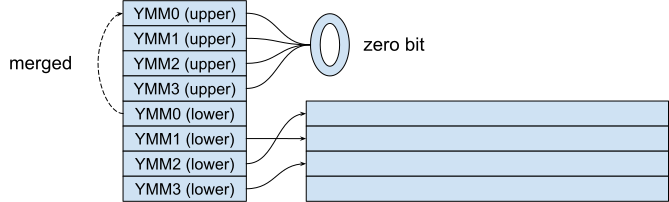
In fact, when you zero an XMM register, the processor
doesn’t store those bits anywhere at all - it just sets a flag called
the z-bit
in the RAT. This flag can be applied to the upper and lower parts of
YMM registers independently, so vzeroupper can
simply set the z-bit and then release any resources assigned to it in
the register file.
Z-Bit
A register allocation table (left) and a physical register file (right).
Speculation
Hold on, there’s another complication! Modern processors use speculative
execution, so sometimes operations have to be rolled back.
What should happen if the processor speculatively executed a
vzeroupper, but then discovers that there was a branch
misprediction? Well, we will have to revert that operation and put
things back the way they were… maybe we can just unset that z-bit?
If we return to the analogy of malloc and
free, you can see that it can’t be that simple - that would
be like calling free() on a pointer, and then changing your
mind!
That would be a use-after-free vulnerability, but there is no such
thing as a use-after-free in a CPU… or is there?
Spoiler: yes there is 🙂
Zenbleed Demo
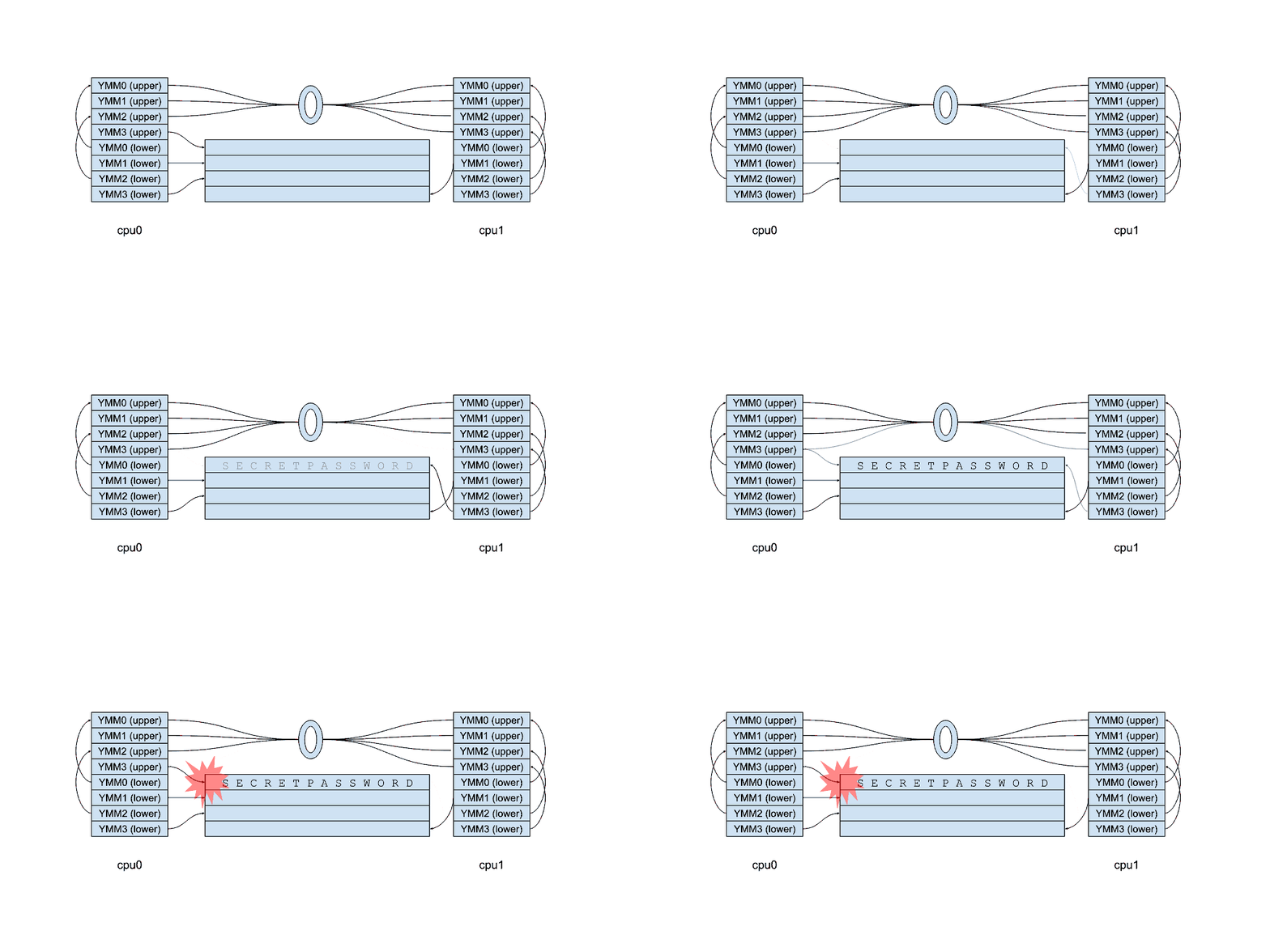
This animation shows why resetting the z-bit is not sufficient.
Vulnerability
It turns out that with precise scheduling, you can cause
some processors to recover from a mispredicted vzeroupper
incorrectly!
This technique is CVE-2023-20593 and it works on all Zen 2 class
processors, which includes at least the following products:
AMD Ryzen 3000 Series Processors
AMD Ryzen PRO 3000 Series Processors
AMD Ryzen Threadripper 3000 Series Processors
AMD Ryzen 4000 Series Processors with Radeon Graphics
AMD Ryzen PRO 4000 Series Processors
AMD Ryzen 5000 Series Processors with Radeon Graphics
AMD Ryzen 7020 Series Processors with Radeon Graphics
AMD EPYC “Rome” Processors
The bug works like this, first of all you need to trigger something
called the XMM Register Merge Optimization2,
followed by a register
rename and a mispredicted vzeroupper. This all has to
happen within a precise window to work.
We now know that basic operations like strlen,
memcpy and strcmp will use the vector
registers - so we can effectively spy on those operations happening
anywhere on the system! It doesn’t matter if they’re happening in other
virtual machines, sandboxes, containers, processes, whatever!
This works because the register file is shared by everything on the
same physical core. In fact, two hyperthreads even share the same
physical register file.
Don’t believe me? Let’s write an exploit 🙂
Exploitation
There are quite a few ways to trigger this, but let’s examine a very
simple example.
Here cvtsi2sd is used to trigger the merge optimization.
It’s not important what cvtsi2sd is supposed to
do, I’m just using it because it’s one of the instructions the manual
says use that optimization3.
Then we need to trigger a register
rename, vmovdqa will work. If the conditional branch4 is taken but the CPU predicts the
not-taken path, the vzeroupper will be mispredicted and the
bug occurs!
Optimization
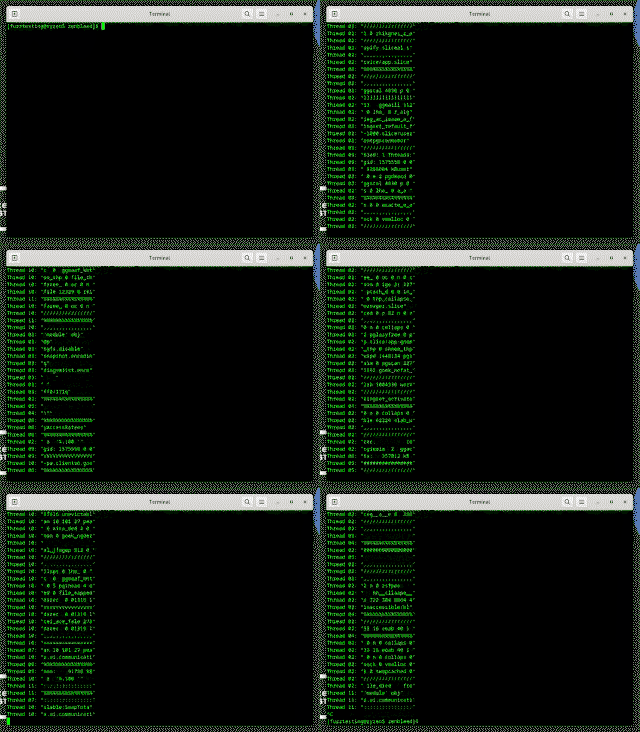
Exploit Running
It turns out that mispredicting on purpose is difficult to optimize!
It took a bit of work, but I found a variant that can leak about 30 kb
per core, per second.
This is fast enough to monitor encryption keys and passwords as users
login!
We’re releasing our full technical advisory, along with all the
associated code today. Full details will be available in our security
research repository.
If you want to test the exploit, the code is available here.
Note that the code is for Linux, but the bug is not dependent on any
particular operating system - all operating systems are affected!
Discovery
I found this bug by fuzzing, big surprise 🙂 I’m not the first person
to apply fuzzing techniques to finding hardware flaws. In fact, vendors
fuzz their own products extensively - the industry term for it is
Post-Silicon Validation.
So how come this bug wasn’t found earlier? I think I did a couple of
things differently, perhaps with a new perspective as I don’t have an EE
background!
Feedback
The best performing fuzzers are guided by coverage feedback.
The problem is that there is nothing really analogous to code coverage
in CPUs… However, we do have performance
counters!
Feeding this data to the fuzzer lets us gently guide it towards
exploring interesting features that we wouldn’t have been able to find
by chance alone!
It was challenging to get the details right, but I used this to teach
my fuzzer to find interesting instruction sequences. This allowed me to
discover features like merge optimization automatically, without any
input from me!
Oracle
When we fuzz software, we’re usually looking for crashes. Software
isn’t supposed to crash, so we know something must have gone wrong if it
does.
How can we know if a a CPU is executing a randomly generated program
correctly? It might be completely correct for it to crash!
Well, a few solutions have been proposed to this problem. One
approach is called reversi.
The general idea is that for every random instruction you generate, you
also generate the inverse (e.g. ADD r1, r2 →
SUB r1, r2). Any deviation from the initial state at the
end of execution must have been an error, neat!
The reversi approach is clever, but it makes generating testcases
very complicated for a CISC architecture like x86.
A simpler solution is to use an oracle. An oracle is just
another CPU or a simulator that we can use to check the result. If we
compare the results from our test CPU to our oracle CPU, any mismatch
would suggest that something went wrong.
I developed a new approach with a combination of these two ideas, I
call it Oracle Serialization.
Oracle Serialization
As developers we monitor the macro-architectural state,
that’s just things like register values. There is also the
micro-architectural state which is mostly invisible to us, like
the branch predictor, out-of-order
execution state and the instruction pipeline.
Serialization lets us have some control over that, by
instructing the CPU to reset instruction-level
parallelism. This includes things like store/load barriers,
speculation fences, cache line flushes, and so on.
The idea of a Serialized Oracle is to generate a random program, then
automatically transform it into a serialized
form.
movnti [rbp+0x0],ebx
movnti [rbp+0x0],ebx
sfence
rcr dh,1
rcr dh,1
lfence
sub r10, rax
sub r10, rax
mfence
rol rbx, cl
rol rbx, cl
nop
xor edi,[rbp-0x57]
xor edi,[rbp-0x57]
: A randomly generated sequence of instructions, and the same sequence
but with randomized alignment, serialization and speculation fences
added.
These two program might have very different performance
characteristics, but they should produce identical output. The
serialized form can now be my oracle!
If the final states don’t match, then there must have been some error
in how they were executed micro-architecturally - that could indicate a
bug.
This is exactly how we first discovered this vulnerability, the
output of the serialized oracle didn’t match!
Solution
We reported this vulnerability to AMD on the 15th May 2023.
AMD have released
an microcode update for affected processors. Your BIOS or Operating
System vendor may already have an update available that includes it.
Workaround
It is highly recommended to use the microcode update.
If you can’t apply the update for some reason, there is a software
workaround: you can set the chicken bitDE_CFG[9].
This may have some performance cost.
Linux
You can use msr-tools to set the chicken bit on all
cores, like this:
# wrmsr -a 0xc0011029 $(($(rdmsr -c 0xc0011029) | (1<<9)))
FreeBSD
On FreeBSD you would use cpucontrol(8).
Others
If you’re using some other operating system and don’t know how to set
MSRs, ask your vendor for
assistance.
Note that it is not sufficient to disable
SMT.
Detection
I am not aware of any reliable techniques to detect exploitation.
This is because no special system calls or privileges are required.
It is definitely not possible to detect improper usage of
vzeroupper statically, please don’t try!
Conclusion
It turns out that memory management is hard, even in silicon 🙂
Acknowledgements
This bug was discovered by me, Tavis Ormandy from Google Information
Security!
I couldn’t have found it without help from my colleagues, in
particular Eduardo Vela Nava and Alexandra Sandulescu. I also had help
analyzing the bug from Josh Eads.