We have a CPU mystery! We found a way to cause some processors to
enter a glitch state where the normal rules don’t apply, but what does
that mean…?
If you’re interested what can go wrong inside modern CPUs, read
on!
Introduction
If you’ve ever written any x86 assembly at all, you’ve probably used
rep movsb. It’s the idiomatic way of moving memory around
on x86. You set the source, destination,
direction and the count - then just let the processor
handle all the details!
The actual instruction here is movsb, the
rep is simply a prefix that changes how the instruction
works. In this case, it indicates that you want this operation
repeated multiple times.
There are lots of other prefixes too, but they don’t all apply to
every instruction.
Prefix Decoding
An interesting feature of x86 is that the instruction decoding is
generally quite relaxed. If you use a prefix that doesn’t make sense or
conflicts with other prefixes nothing much will happen, it will usually
just be ignored.
This fact is sometimes useful; compilers can use redundant prefixes
to pad a single instruction to a desirable alignment boundary.
Take a look at this snippet, this is exactly the same code as above,
just a bunch of useless or redundant prefixes have been added:
Perhaps the most interesting prefixes are rex,
vex and evex, all of which change how
subsequent instructions are decoded.
Let’s take a look at how they work.
The REX prefix
The i386 only had 8 general purpose registers, so you could specify
which register you want to use in just 3 bits (because 2^3 is 8).
The way that instructions were encoded took advantage of this fact,
and reserved just enough bits to specify any of those
registers.
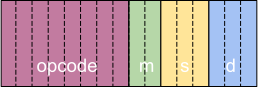
modr/m example
Simple 2-byte instructions that use modr/m might be encoded like
this, for example mov eax, ebx.
This is an 8-bit opcode, 2 bit addressing mode (labeled m), and 3
bits each for the source (s) and destination (d).
Well, this is a problem, because x86-64 added 8 additional general
purpose registers. We now have sixteen possible registers..that’s 2^4,
so we’re going to need another bit! 😆
The solution to this is the rex prefix, which gives us
some spare bits that the next instruction can borrow.
When we’re talking about rex, we usually write it like this:
rex.rxb
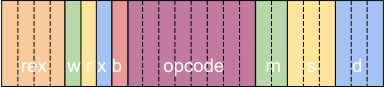
rex is a single-byte prefix, the first four bits are
mandatory and the remaining four bits called b,
x, r and w are all optional. If
you see rex.rb that means only the r and
b bits are set, all the others are unset.
These optional bits give us room to encode more general purpose
registers in the following instruction.
rex example
The rex prefix can lend the next instruction extra bits
to use for operands, so now we can encode all 16 possible general
purpose registers!
So now we know that rex increases the available space
for encoding operands, and that useless or redundant prefixes are
usually ignored on x86. So… what should this instruction do?
rex.rxb rep movsb
The movsb instruction doesn’t have any operands -
they’re all implicit - so any rex bits are meaningless,
right?
If you guessed that the processor will just silently ignore the
rex prefix, you would be correct!
Well… except on machines that support a new feature called fast
short repeat move! We discovered that a bug with redundant
rex prefixes could interact with this feature in an
unexpected way and introduce a serious vulnerability, oops 🙂
Fast Short Repeat Move
FSRM is a new feature introduced in Ice
Lake that fixes some of the shortcomings of ERMS. Hopefully that
clears up any confusion. 😆
Just kidding, let’s quickly look at ERMS.
The hard part of moving strings around efficiently is getting all the
buffers aligned so you can use the widest possible stores available. You
could do this in software, but if we do it in microcode then
the processor can just transparently make your existing code faster for
you.
This requires some expensive setup, but once that’s done you get
vastly improved throughput. This feature is known as enhanced repeat
move/store, ERMS.
If you have a processor with ERMS support, simple
rep movsb operations can sometimes perform comparably with
more complicated hand-tuned vector move operations.
However, there is a problem with ERMS. That initial setup is so
expensive that it just isn’t worth it for very short strings. This is
what FSRM is designed to solve, it handles the case of only moving 128
bytes or less and makes that faster too!
I’m not aware of any documentation that explains exactly how FSRM
works, but you can check if you have a processor that supports it by
looking at the flags line in /proc/cpuinfo:
flags : fpu vme de pse tsc msr pae mce cx8 [...] fsrm
Some of the processors that have this feature include:
Ice Lake
Rocket Lake
Tiger Lake
Raptor Lake
Alder Lake
Sapphire Rapids
Note: This list may not be comprehensive, please see Intel advisory
INTEL-SA-00950 for a complete list.
Discovery
I’ve written previously about a processor validation technique called
Oracle Serialization that we’ve been using. The idea is to
generate two forms of the same randomly generated program and verify
their final state is identical.
You can read more about Oracle Serialization in my previous writeup.
In August, our validation pipeline produced an interesting assertion.
It had found a case where adding redundant rex.r prefixes
to an FSRM optimized rep movs operation seemed to cause
unpredictable results.
We observed some very strange behavior while testing. For example,
branches to unexpected locations, unconditional branches being ignored
and the processor no longer accurately recording the instruction pointer
in xsave or call instructions.
Oddly, when trying to understand what was happening we would see a
debugger reporting impossible states!
This already seemed like it could be indicative of a serious problem,
but within a few days of experimenting we found that when multiple cores
were triggering the same bug, the processor would begin to report
machine check exceptions and halt.
We verified this worked even inside an unprivileged guest VM, so this
already has serious security implications for cloud providers.
Naturally, we reported this to Intel as soon as we confirmed this was a
security issue.
Reproduce
We’re publishing all of our research today to our security
research repository. If you want to reproduce the vulnerability you
can use our icebreak tool, I’ve also made a local mirror
available here.
$ ./icebreak -h
usage: ./icebreak [OPTIONS]
    -c N,M      Run repro threads on core N and M.
    -d N        Sleep N usecs between repro attempts.
    -H N        Spawn a hammer thread on core N.
icebreak: you must at least specify a core pair with -c! (see -h for help)
The testcase enters what should be an infinite loop, and unaffected
systems should see no output at all. On affected systems, a
. is printed on each successful reproduction.
$ ./icebreak -c 0,4
starting repro on cores 0 and 4
.........................................................................
.........................................................................
.........................................................................
.........................................................................
.........................................................................
In general, if the cores are
SMT siblings then you may
observe random branches and if they’re SMP siblings from the same
package then you may observe machine checks.
If you do not specify two different cores, then you might
need to use a hammer thread to trigger a reproduction.
Analysis
We know something strange is happening, but how microcode works in
modern systems is a closely guarded secret. We can only theorize about
the root cause based on observations.
μops
The CPU is split in two major components, the frontend and
the backend. The frontend is responsible for fetching
instructions, decoding them and generating μops to send to the backend
for execution.
The backend executes instructions out of order, and uses a
unit called the ROB, reorder buffer, to store and organize
results.
We believe this bug causes the frontend to miscalculate the size of
the movsb instruction, causing subsequent entries in the
ROB to be associated with incorrect addresses. When this happens, the
CPU enters a confused state that causes the instruction pointer to be
miscalculated.
The machine can eventually recover from this state, perhaps with
incorrect intermediate results, but becoming internally consistent
again. However, if we cause multiple SMT or SMP cores to enter the state
simultaneously, we can cause enough microarchitectural state corruption
to force a machine check.
Questions
I’m sure some readers will have questions about what is possible in
this unexpected “glitch” state. Well, so do we!
We know that we can corrupt the system state badly enough to cause
machine check errors, and we’ve also observed threads interfere with
execution of processes scheduled on SMT siblings.
However, we simply don’t know if we can control the corruption
precisely enough to achieve privilege escalation. I suspect that it
is possible, but we don’t have any way to debug μop
execution!
If you’re interested in studying this, then we would love to get your
input!
Credit
This bug was independently discovered by multiple research teams
within Google, including the silifuzz team and Google
Information Security
Engineering. The bug was analyzed by Tavis Ormandy, Josh Eads,
Eduardo Vela Nava, Alexandra Sandulescu and Daniel Moghimi.
Solution
Intel have published
updated microcode for all affected processors. Your operating system or
BIOS vendor may already have an update available!
Workaround
If you can’t update for some reason, you could disable fast
strings via the IA32_MISC_ENABLE model specific
register.
This will cause a significant performance penalty, and should not be
used unless absolutely necessary.
Notes
If you’re interested in more CPU bugs, we publish everything we
find!
Not all the bugs we discover have security consequences, but they’re
usually worth reading! For example, did you know that sometimes movlps
just doesn’t work? or that registers can sometimes roll
back to previous values?